


Our Services
Book Binding

London's CREATIVE Print Partner
Professional perfect, case and section-sewn book binding, alongside saddle stitch binding for slimmer publications. Choose a format suited to your page count, intended use and finish, with expert support from specification through to production.

-

Four principal binding routes
-
Commercial publication support
-
Softback and hardback production
-
Stocks, covers and finishes

Binding Options

Case Bound or Hardback Books
Case Bound or Hardback Books
Case Binding or Hardback binding is one of the most common binding types we do for obvious reasons. Where run lengths and budget allows it can be combined with section sewn text sections to help the books lay flatter, and with any of the finishing cover options outlined in the section below. Some cover types such as cloth covers work best on casebound books. You can see casebound books in our work examples.

Lay Flat Books
Lay Flat Books
As the name suggests both the spine of the book and the pages are designed to lay flat when in use. Typically need to be longer run lengths to make lay flat economically effective per copy (200 copies plus). Very effective for highly visual, large picture books.

Naked Bound
Naked Bound
Leaving the threads of the spine visible is called naked binding, and can be combined with section sewing to great visual effect especially with different coloured threads. It can be used essentially without covers making a feature of the groups of pages, or add covers in the Swiss binding style. As with any section sewing it is generally accepted this binding method is for longer runs of at least 200-400 copies to make it commercially viable.

OTA Bound Books
OTA Bound Books
OTA binding is for softcover books and is designed to help the book open flatter as a casebound book would do. It works by hinging the cover on the text section as shown in the photo above. Ideally suited to work in combination with section sewing so is more ideally suited to longer run lengths of a minimum of 200 copies.

PUR Bound or Softback Books
PUR Bound or Softback Books
The variation in softcovers we offer is hugely varied – from Colorplan coloured card covers through to Kraft covers and into all sorts of other specialist papers. If you have an idea for your books and are not sure if it can be done, ask us. We often duplex softcovers to thicken them and make them a half way house between soft and hard covers. Take a look at softcover books in our work examples.

Saddle Stitched (Stapled)
Saddle Stitched (Stapled)
Most commonly used for brochures but saddle stitching is also used for books with fewer pages – really 44 pages including the cover is about the limit before the spine starts to bulge too much to look good. Can be combined with specialist papers to enhance the impression given and/or with any of the cover options below.

Screw Bound Books
Screw Bound Books
Screw bound books look different, are very flexible in terms of how they work with their content and work very well as presentation books – because they can be dis-assembled and the content updated without losing the covers – which are often the expensive parts. Available in both hardback and softcover. Take a look at the work examples in our portfolio

Swiss Bound
Swiss Bound
With Swiss Bound the cover (which can be either hard or soft) hinges on just one side. The result leaves the spine open to view as in the image above, or it is often wrapped in cloth. As it is usually combined with section sewing it is generally accepted this binding method is for longer runs of at least 300-400 copies to make it commercially viable.

Wiro Bound Books
Wiro Bound Books
Available in hardback and softback options, and very popular with the journals, diaries, planners and notebooks market because the wire allows the book to lay completely flat – handy when you need to write in it! Various wire colours are available, along with ribbon markers and any of the cover options listed below.
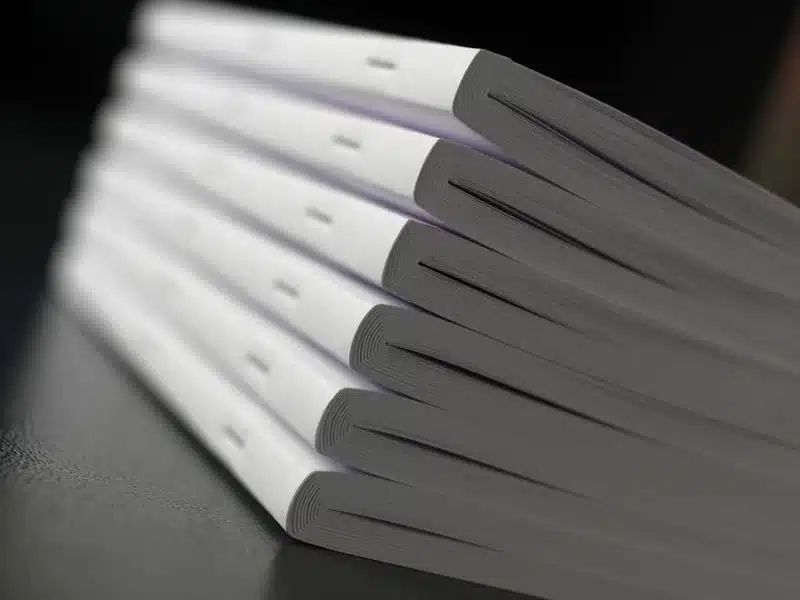
Squareback Saddle Stitching
Squareback Saddle Stitching
Squareback Saddle Stitching refers to a binding method where folded pages are stapled through the spine (saddle stitched) and then pressed to create a flat, square spine, giving the booklet a more premium, book-like appearance while making it easier to stack, store, and display.
How should I choose a binding method?
Perfect binding printing services suit many square-spined paperback books and brochures. Perfect binding book printing and perfect bound book printing are often chosen for reports, catalogues, journals and other publications that need a clean softback finish. Perfect bound brochure printing is also suitable for more substantial brochures, while perfect bound brochures give enough spine width for a title where the specification allows. Ask about perfect binding printing or perfect bound printing when you want a professional softcover format.
When is case binding appropriate?
Case binding services create rigid hard covers for premium or long-lasting publications. Freestyle can advise on case bound binding, case bound book binding and casebound book binding according to the cover construction, text block and intended use. When comparing case bound book printers, provide details of any cloth, printed paper, foil, endpaper or dust-jacket requirements. This helps establish the right approach to case bound book printing.
What does section sewing add?
With section sewn binding, printed sheets are folded into groups and sewn before the text block is bound. Section sewn book binding can improve strength and help a larger book open more comfortably. The terms section stitching binding, sewn binding book and sewn binding book printing may be used for related requirements. For sewn bound books, page extent, quantity and construction affect whether sewing is commercially appropriate.
When does saddle stitching work best?
Saddle stitch binding secures nested folded sheets through the centre fold and is generally best for slimmer publications. Saddle stitch printing can be used for brochures, programmes and reports, while saddle stitch booklet printing is a practical option for branded saddle stitch booklets. Freestyle can also advise on saddle stitch calendar printing, saddle stitch catalog printing and saddle stitch notebook printing where the page count and format are suitable. For a saddle stitched brochure or saddle stitch binding printing enquiry, page count normally needs to work in multiples of four.
What should I provide for a quote?
Provide the finished size, total page count, quantity, text and cover stocks, colour specification, preferred binding method, required finishes, artwork status and delivery date. For brochure binding, also explain how the publication will be used and whether repeat production is expected. Paper weight and page count influence bulk, spine width and opening behaviour, so a dummy or proof may be recommended before production.
FAQs
Perfect binding secures pages into a square-spined wraparound cover. Saddle stitching nests folded sheets and fixes them through the centre fold, making it better suited to slimmer publications.
Case binding describes the rigid outer cover. Section sewing describes how folded groups of pages are sewn together. The two methods can be combined for a strong hardback book that opens more comfortably.
A slim brochure will often suit saddle stitching, while a publication with more pages may suit perfect binding. Brochure binding should be selected around page count, paper weight, required lifespan, appearance, quantity and budget.
Yes. Depending on the construction, covers may use specialist papers and finishes such as foiling, embossing, debossing, Spot UV, lamination or die cutting.
Supply the finished size, page count, quantity, text and cover stocks, colour requirements, preferred binding method, finishes, artwork status, delivery date and whether the order is likely to repeat.
Why Choose Freestyle Print

Established in 2000, we have over 26 years of print industry experience, that assures your print project is handled and completed correctly right from the word go.
About usWe take the time to understand your project before recommending the right print solution, ensuring it fits your goals, budget and timescale. If there's a better or more cost-effective option for your needs, we'll recommend it—because the best advice is always what's right for you.
Freestyle Print provides flexible printing solutions suitable for everything from a single copy to large production runs. Using modern digital and lithographic printing technologies, they can efficiently handle both small quantities and high-volume orders without compromising quality. This flexibility allows businesses to produce anything from one-off projects and prototypes to large-scale marketing materials and packaging runs tailored to their needs.
Clients can choose from an extensive selection of papers, card stocks, and specialty materials to achieve the desired look and feel for their printed products. Options include coloured papers, recycled materials, kraft stocks, and premium ranges such as Colorplan and Fedrigoni. Finishing techniques such as foiling, embossing, debossing, spot UV, laminating, die cutting, duplexing, and painted or gilt edging allow brands to create distinctive printed materials that stand out.
Freestyle Print combines advanced digital, lithographic, and large-format printing technologies with specialist finishing equipment to deliver consistently high-quality results. Their in-house production process ensures precise colour reproduction, crisp detail, and professional finishing for a wide range of products, including brochures, packaging, stationery, and display graphics. This integrated approach helps maintain strict quality control from printing through to final finishing.
Because printing and finishing are completed in-house, Freestyle Print can respond quickly to urgent projects and tight deadlines. Many services offer rapid production, with options for same-day printing and delivery when required. Dedicated production workflows and courier delivery ensure that printed materials are produced efficiently and delivered promptly to meet client timelines.